

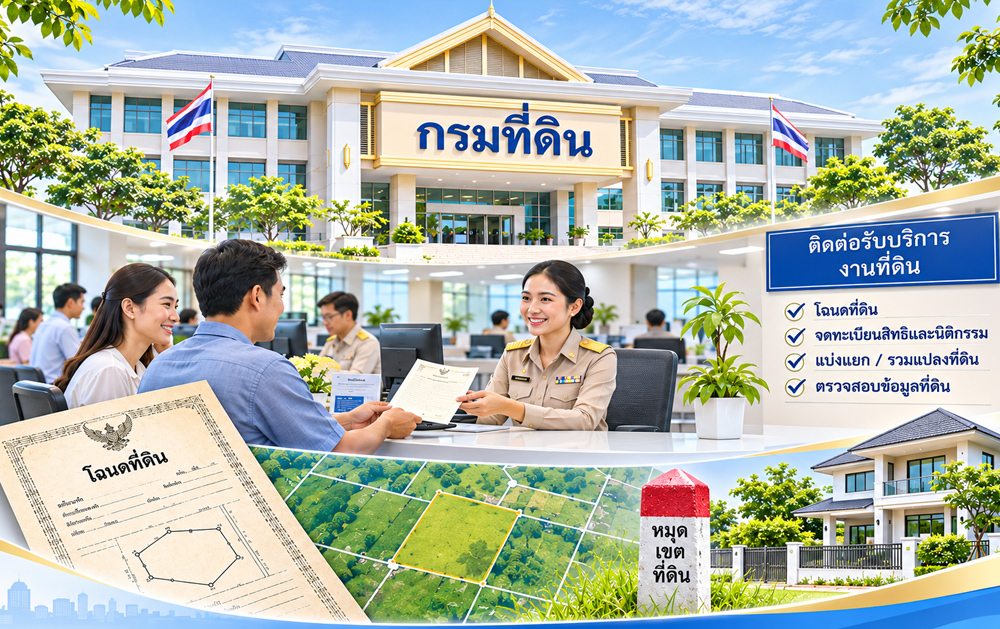
For Thai nationals living abroad who are looking to acquire a home or real estate in Thailand, understanding the role of the Department of Lands is essential. It is the key to ensuring that the processes of purchasing and transferring ownership proceed smoothly and without complications. Most importantly, it helps avoid the need for multiple, repetitive visits to handle paperwork—a task that can become significantly more complex and burdensome when you are based overseas.
What is the Department of Lands and what is its role?
The Department of Lands is a government agency under the Ministry of Interior. Its primary responsibility is the management of all land in Thailand—ranging from the issuance of title deeds and land surveying to the registration of land and real estate rights and legal transactions, as well as the collection of relevant fees and taxes.
- Issuance of Title Documents: The Department of Lands is responsible for issuing land title deeds (such as *Chanot* or *N.S. 3 Kor* documents) and other official papers that confirm the right to possess and utilize a piece of land.
- Registration of Rights and Legal Transactions: Any change in rights concerning land or real estate—such as sales, transfers, mortgages, subdivisions, or the consolidation of title deeds—must be officially registered at the local Land Office in the relevant jurisdiction.
…to ensure legal validity.
- Land Valuation: Used as a basis for calculating fees and taxes for various legal transactions.
- Land Surveying: The process of verifying and establishing land boundaries in accordance with the law.
Therefore, for Thai nationals living abroad, purchasing a home or real estate in Thailand requires navigating processes involving the Department of Lands.
Why should Thai nationals living abroad pay special attention to matters concerning the Department of Lands?
For Thai nationals working or residing overseas, purchasing a home in Thailand presents challenges related to time and distance. Traveling back to handle documentation in person may be inconvenient. While it is possible to grant power of attorney to another person to act on one’s behalf at the Department of Lands, it is essential to be fully informed; granting power of attorney carries higher risks. Furthermore, one must understand the specific procedures, the types of documents required, and the necessary content for preparing these documents. A lack of understanding regarding the documentation can lead to various issues, such as:
- Incomplete or Incorrect Documentation: This necessitates additional time to obtain or correct the documents, which can be a lengthy process and may incur extra costs.
- Defective Power of Attorney:
- Delays in the process: Incomplete or erroneous documentation can cause delays in the property transaction.
- Legal risks: Failure to thoroughly verify the title deed could lead to issues such as the land being mortgaged, subject to encumbrances, or involving boundary disputes.
Furthermore, the signing of a power of attorney is subject to specific requirements mandated by both the Department of Lands and the lender. Therefore, it is crucial to prepare, research the necessary information, and seek professional guidance to ensure all documentation is in order beforehand.
When must you visit the Land Office?
If you are based abroad and purchasing a property in Thailand, the primary step requiring your presence at the Land Office is the registration of the transfer of ownership. If the purchase is financed through a mortgage, the transfer of ownership and the registration of the mortgage are typically conducted on the same day. The signing of the Sale and Purchase Agreement and the mortgage application process take place prior to this date.
1. Before paying a deposit, verify the title deed and registration details.
Ensure that the owner’s name on the title deed matches the identity of the seller. Also, check for any encumbrances that could affect the transfer, such as a mortgage or other obligations. If there is any uncertainty regarding property boundaries, clarify these details before agreeing to the purchase.
If the property is currently mortgaged, the seller should coordinate with their existing bank to obtain the redemption amount and inquire about the time required to prepare the necessary documentation. This allows for the redemption of the existing mortgage and the transfer of ownership to be scheduled for the same day, once all parties are ready.
2. Before the scheduled transfer: Prepare documents and ensure all parties are ready
- Cash purchase: Schedule the transfer date with the seller once all documents and the remaining balance are ready.
- Purchase via mortgage loan: Wait for the bank to approve the loan and confirm their readiness to proceed with the legal transaction; then, coordinate the transfer date with both the seller and the bank.
If you intend to authorize someone else to handle the transfer on your behalf, ensure that all necessary documentation is prepared correctly—such as using the appropriate forms and clearly defining the scope of the authorization. Furthermore, if any documents are signed abroad, verify the required certification procedures to ensure they comply with the regulations of the Department of Lands….the Land Office and the lending bank, as well as preparing any additional documentation required for individuals with foreign spouses.
3. What happens at the Land Office on the day of the property transfer?
The buyer and the seller—or their respective authorized representatives—submit the necessary documents and sign them in the presence of a Land Office official. If the purchase is financed through a bank, the bank will coordinate the mortgage registration process according to its own procedures. Generally, the following key steps take place on the scheduled date:
- Document Verification: The Land Office official examines the title deed, the documents provided by both parties, and any powers of attorney, if applicable.
- Payment of the Remaining Balance: The buyer pays the remaining portion of the purchase price as agreed.
- Payment of Applicable Fees and Taxes: This includes the transfer fee, stamp duty, and other relevant taxes—such as the Specific Business Tax and withholding income tax—based on the amounts calculated by the Land Office.
- Registration of Ownership Transfer: The Land Office official records the transfer in the registration ledger attached to the title deed.
Once the registration is complete, the buyer acquires ownership of the property.
- Mortgage Registration: If the purchase is financed through a loan, a mortgage must be registered on the property to serve as collateral for the bank providing the loan.
3. After the Transfer of Ownership
Verify the buyer’s name and the details of the ownership transfer registration. Keep copies of all relevant documents and receipts, then proceed with necessary follow-up tasks, such as:
- Registering a change of address in the household registration (Tabien Baan) and obtaining a new household registration document.
- Applying for the installation or transfer of utility services, such as electricity, water, and telephone services.
- Other matters, such as the payment of annual land and building taxes.
Common Challenges for Thais Living Abroad
- Delays in Loan Approval: A lack of understanding regarding the preparation of financial documents and other supporting paperwork required for a loan application can lead to delays in the bank’s loan approval process.
- Insufficient loan amount: The approved loan amount may not meet your needs, leaving you with insufficient time to complete the property ownership transfer by the date scheduled by the seller.
- Incomplete or incorrect documentation: This includes providing documents with inaccurate information, errors, missing entries, or failing to prepare all the necessary paperwork—both for the loan application and for the requirements of the Department of Lands.
- Lack of understanding regarding fees and taxes: Failure to estimate total costs in advance can lead to insufficient funds to cover the balance of the property price and the various expenses due on the day of the ownership transfer.
- Unfamiliarity with the required procedures.
For Thai nationals living abroad who plan to purchase a home in Thailand and intend to use a mortgage, it is advisable to first assess your potential loan amount and prepare documentation of your foreign-earned income before placing a deposit. Once you have selected a property, allow sufficient time to verify the title deed and ownership documents. If you plan to authorize someone else to handle the ownership transfer on your behalf, ensure that all required documents are verified with both the Department of Lands and the bank in advance, so that all parties are fully prepared on the scheduled transfer date.
Those interested in the GH Bank (GHB) mortgage program for Thai nationals living abroad can find further details on the Government Housing Bank’s website. Alternatively, you may seek advice from Sun Gateway—an authorized agent for the Government Housing Bank (GHB) for this project—regarding the preparation of documents and the process for applying for a loan from abroad.
If you are interested in applying or would like more information, please contact us:
